Executive Summary
The Performance Section of the Brazilian Department of Airspace Control (DECEA) and the Performance Review Unit (PRU) of EUROCONTROL jointly developed this edition of the Brazil–Europe Comparison of Air Navigation System Performance report. This bi-regional report builds on previous comparative analyses and is based on commonly agreed performance metrics and definitions, enabling a consistent assessment of air navigation service performance over time. By extending the observation period to 2019–2025, this edition supports a comprehensive analysis of long-term performance trends, encompassing the pre-COVID, the pandemic disruption, and the subsequent recovery phase.
This report and previous editions are available via the web-portals of both organisations:
This edition expands on the previous comparisons of the Brazilian and European air navigation systems by focussing on the observed performance post COVID, extending the time frame, and incorporating additional analyses. For example, a more detailed characterisation of the Brazilian and European network is included. An initial assessment of horizontal flight efficiency demonstrates the widening scope of this report. This is also complemented by an exploratory assessment of the runway pressure to characterise operational concepts at the study airports. Both aspects promise to enable further analyses and studies for future editions. These focussed topics allow to address discussions about performance benefits and may help to highlight the differences between the operations in both regions.
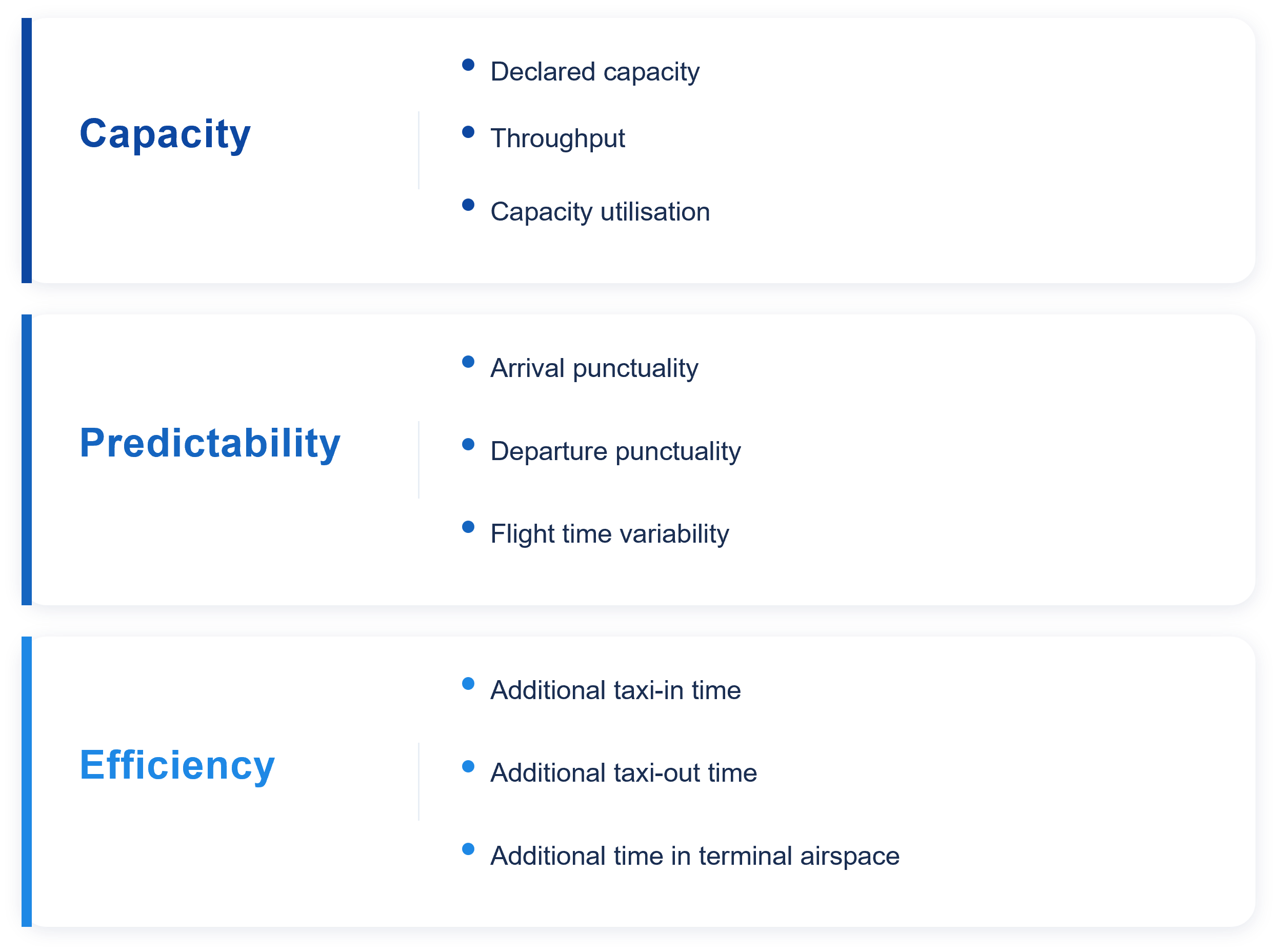
The report focuses on a subset of the eleven Key Performance Areas identified by the ICAO Global Air Navigation Plan, in particular Predictability, Capacity and Efficiency.
The 2025 bi-regional comparison of the Brazilian and European air navigation systems highlights a transition from pandemic recovery to a new baseline of normalized, organic growth.
Key take-aways from this edition include:
Strategic Institutional Alignment: The sustained collaboration between DECEA and EUROCONTROL remains a cornerstone of this initiative. By sharing high-fidelity data and operational experiences, both organizations continue to drive the evolution of global ATM performance management and the validation of ICAO GANP indicators.
Workforce Efficiency and Scalability: While traffic levels increased, the Brazilian ATCO workforce remained remarkably stable (+0.1% growth). This indicates that DECEA is successfully decoupling traffic growth from linear workforce expansion through technological and procedural optimisation.
Traffic Characterisation and System Pressure: The operational environment in Europe is characterized by significantly higher pressure, with a traffic density nearly five times that of Brazil.
- Fleet Mix Complexity: Brazil manages a unique wake turbulence environment, with “Light” aircraft making up to 30% of the mix at airports like SBEG, whereas the European study airports are almost exclusively “Medium” and “Heavy”.
- Infrastructure Benchmarking: European single-runway hubs like London Gatwick and Lisbon operate at a higher peak load index, providing vital benchmarks for Brazilian airports like Santos Dumont (SBRJ) to exploit as demand matures.
- These factors directly influence “achievable” throughput and peak-load management strategies.
Predictability and Scheduling Buffers: Distinct punctuality signatures were observed in 2024 and 2025.
- Brazil maintained a high proportion of “significantly early” arrivals (29% in 2025), suggesting conservative schedule buffering by operators.
- Europe faced continued schedule robustness challenges, with 26% of arrivals more than 15 minutes late, driven by network-wide capacity constraints and high reactionary delays.
- These variations have ripple effects on other performance measures as demand patterns change.
Tactical Operational Efficiency: This report focuses on Additional Taxi-in, Taxi-Out, and Additional ASMA times. These metrics serve as primary indicators for measuring tactical system pressure, airport congestion, and the efficiency of sequencing and metering within the terminal area.
Technical Deep-Dives: Following up on last year’s first deep dive, this report continues to evolve a deeper technical characterisations of operational concepts or performane drivers. The fifth edition includes initial comparative studies on Horizontal Flight Efficiency (HFE) and runway slot pressure..
This report will be updated throughout the coming years under the umbrella of the DECEA-EUROCONTROL memorandum of cooperation. It is also planned to establish a web-based rolling monitoring with regular updates. Future editions will complement the data time series and support the development of further use-case analyses. The lessons learnt of this joint project will be coordinated with the multi-national Performance Benchmarking Working Group (PBWG) and the ICAO GANP Study sub-group concerned with the further development of the GANP Key Performance Indicators (KPIs).